Comparing Two Industrial Surface Preparation Methods
For decades, sandblasting has been one of the most widely used methods for removing rust, paint, coatings, mill scale, and other contaminants from industrial surfaces.
Today, industrial companies have another option: laser cleaning.
As manufacturers, fabricators, contractors, shipyards, restoration companies, and maintenance teams look for more precise and efficient cleaning solutions, the question is becoming increasingly common:
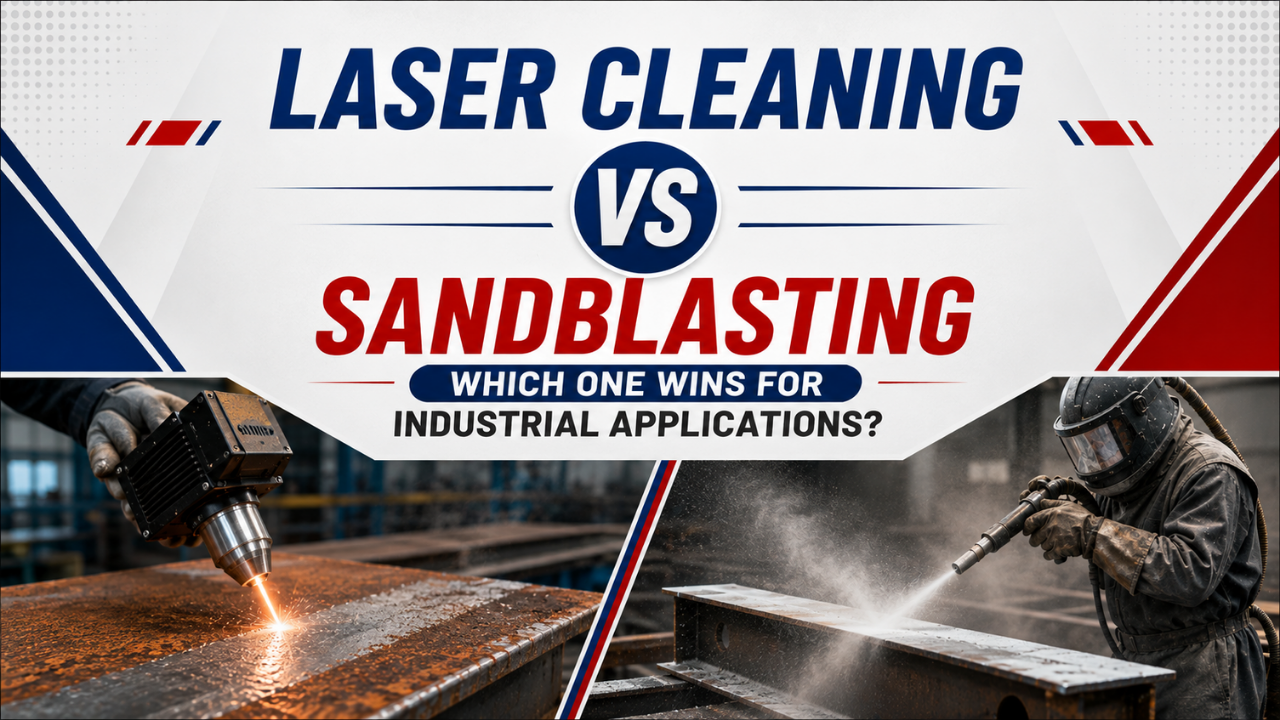
Laser cleaning vs sandblasting: which one is better for industrial applications?
The answer isn’t as simple as saying one method is always better.
Sandblasting remains highly effective for certain large-scale, aggressive surface preparation jobs. Laser cleaning, however, offers significant advantages when precision, substrate protection, reduced consumables, cleaner operation, and controlled removal are priorities.
The right choice depends on the material, contaminant, required surface condition, project size, and what happens after cleaning.
Let’s compare both technologies.
What is Sandblasting?
Sandblasting, more accurately referred to as abrasive blasting, uses compressed air to propel abrasive media at high velocity against a surface.
The impact of the abrasive removes rust, paint, scale, and other contaminants.
Modern abrasive blasting can use different media, including materials such as garnet, glass bead, steel grit, and other specialized abrasives. The specific media is selected based on the substrate and desired surface profile.
Sandblasting has remained popular because it can remove large amounts of material quickly, particularly from large steel structures and heavily contaminated surfaces.
It can also create a surface profile that may be required for certain coating systems.
However, abrasive blasting also creates dust, spent media, and additional cleanup requirements. OSHA identifies respiratory, eye, skin, noise, and other hazards associated with abrasive blasting, making proper containment, PPE, ventilation, and work practices essential.
What is Laser Cleaning?
Laser cleaning uses concentrated laser energy to remove contaminants from a surface through a process known as laser ablation.
Depending on the system and application, the process can remove:
- Rust
- Oxidation
- Paint
- Coatings
- Grease
- Carbon deposits
- Surface contamination
Unlike abrasive blasting, laser cleaning is a non-contact process. The operator controls the laser parameters to target the contaminant while minimizing impact on the underlying substrate.
This makes laser cleaning particularly useful when the surface itself needs to be preserved.
However, laser cleaning is not simply a point-and-shoot process. Proper training, parameter selection, material testing, laser safety controls, and appropriate fume extraction are essential for professional operation.
Laser Cleaning vs Sandblasting: The Key Differences
The biggest difference is how the two technologies interact with the surface.
Sandblasting removes material through physical impact.
Laser cleaning removes contaminants through controlled laser energy.
That fundamental difference affects precision, waste, surface profile, cleanup, and the types of applications where each method performs best.
| Factor | Laser Cleaning | Sandblasting |
| Cleaning method | Non-contact laser ablation | Abrasive impact |
| Consumables | No abrasive media | Requires abrasive media |
| Precision | High | Lower for localized cleaning |
| Surface impact | Can preserve substrate when properly applied | Can alter surface profile |
| Secondary waste | Minimal compared with abrasive blasting | Spent abrasive + removed material |
| Large-area cleaning | Can be slower depending on application | Often highly productive |
| Surface profiling | Lasers can create an anchor profile | Can create an anchor profile |
| Setup and containment | Often simpler, depending on job | May require significant containment |
| Training | Specialized laser operation and safety | Blasting operation, PPE, containment |
| Best suited for | Precision and controlled cleaning | Large-area and aggressive surface preparation |
The important point is that these technologies solve different problems.
Where Laser Cleaning Wins
1. Precision Cleaning
Laser cleaning provides much greater control over where material is removed.
This is particularly valuable when an operator needs to clean a specific area without aggressively affecting surrounding surfaces.
Applications can include:
- Precision components
- Weld areas
- Machinery
- Molds
- Restoration work
- Sensitive metal surfaces
For applications where maintaining dimensional accuracy or surface integrity matters, laser cleaning can have a significant advantage.
2. Reduced Consumable Costs
Sandblasting continuously requires abrasive media.
Depending on the project, companies may also need to account for containment materials, collection systems, cleanup labor, and disposal.
Laser cleaning doesn’t require abrasive media. This can reduce recurring consumable expenses and simplify logistics.
The economics still depend on the application, machine utilization, labor, and project requirements, but removing the need for blasting media can make a meaningful difference over time.
3. Less Secondary Waste
One of the biggest challenges with abrasive blasting is that the abrasive becomes part of the waste stream.
If you’re removing old paint or other coatings, the spent abrasive can become contaminated with the material being removed.
OSHA notes that abrasive blasting operations may require specialized systems for collecting, separating, and managing abrasive and contaminant waste.
Laser cleaning eliminates the spent abrasive component.
That doesn’t mean laser cleaning creates zero airborne contaminants. The removed coating, rust, or other material can still generate fumes and particulates, which is why appropriate extraction and safety controls are important.
4. Minimal Surface Contact
Sandblasting physically impacts the surface.
That can be useful when a roughened profile is desired, but it can also be undesirable when the substrate needs to remain as close to its original condition as possible.
Laser cleaning is non-contact and can be precisely controlled.
For high-value components and applications where excessive material removal is a concern, this can be a major advantage.
5. Easier Access to Detailed Areas
Laser cleaning can be particularly useful for intricate components, corners, welds, edges, and areas where abrasive media is difficult to control.
The operator can target specific areas instead of covering the entire surface with abrasive material.
Why Laser Cleaning Is Gaining Ground in Industrial Applications
Laser cleaning is becoming an increasingly attractive solution for industrial surface preparation because it combines precision, flexibility, and reduced consumable use.
1. Versatile Surface Preparation
Modern laser cleaning systems can handle applications ranging from localized rust and corrosion removal to paint stripping, weld cleaning, and larger industrial surfaces.
2. Controlled Surface Profile
Depending on the laser technology and operating parameters, laser cleaning can remove contaminants while also creating or modifying surface texture when required for subsequent coating applications.
The final profile depends on factors such as laser power, scanning speed, frequency, material, and number of passes. Application testing helps determine the right settings for the required surface condition.
3. Multiple Industrial Applications
A commercial laser cleaning system can support a wide range of applications, including:
- Rust and corrosion removal
- Paint and coating removal
- Weld cleaning
- Surface preparation
- Equipment restoration
- Industrial maintenance
This versatility allows contractors and industrial businesses to use the same technology across multiple projects and industries.
What About Cost?
Cost is often where the comparison gets complicated.
Sandblasting typically has a lower equipment entry point, but operating costs can include:
- Abrasive media
- Media transportation
- Containment
- Cleanup
- Waste disposal
- Labor
- Dust collection
- Respiratory protection
- Equipment maintenance
Laser cleaning typically requires a higher initial equipment investment, but it can reduce or eliminate many consumable expenses.
The real comparison should therefore be based on total cost of ownership, not simply the purchase price of the equipment.
Factors to evaluate include:
- Cost per project
- Labor hours
- Cleaning speed
- Consumables
- Cleanup requirements
- Waste disposal
- Equipment utilization
- Downtime
- Maintenance
- Customer requirements
Clean Laser Technologies has previously examined the five-year financial comparison between laser cleaning and sandblasting, emphasizing that businesses should evaluate long-term operating costs rather than focusing exclusively on initial equipment price.
Safety Considerations
Neither technology should be considered risk-free.
Sandblasting involves high-velocity abrasive media and can generate hazardous dust depending on the material being removed and the abrasive used. OSHA recommends appropriate engineering controls, PPE, respiratory protection, and work practices for abrasive blasting operations.
Laser cleaning introduces a different set of hazards.
Industrial laser systems can present serious eye and skin hazards, particularly with Class 4 systems. Operators need appropriate laser safety procedures, controlled work areas, PPE, beam management, and fume extraction based on the application.
This is one reason professional laser cleaning training is so important.
At Clean Laser Technologies, hands-on training covers machine operation, parameter adjustment, safety procedures, maintenance, troubleshooting, and real-world applications.
Which Method is Better for Industrial Applications?
The answer depends on the job.
Laser cleaning may be the better choice when you need:
- High precision
- Controlled contaminant removal
- Minimal abrasive waste
- Reduced consumable use
- Protection of the underlying substrate
- Cleaning around sensitive components
- Localized cleaning
- Weld cleaning
- Precision restoration
- Cleaner maintenance operations
Sandblasting may be the better choice when you need:
- High-volume large-area preparation
- Aggressive removal
- Heavy rust or coating removal
- A defined surface profile for a coating system
- Fast preparation of large structural surfaces
And in some industrial operations, both technologies can have a place.
The goal isn’t to eliminate sandblasting simply because laser cleaning exists.
The goal is to choose the technology that makes the most sense for the application.
Why Testing Matters Before Choosing
Every surface behaves differently.
The material, contaminant, coating thickness, laser parameters, required finish, production speed, and downstream process all affect the result.
That’s why a test area can be one of the most valuable steps before committing to a full production process.
A professional evaluation can help determine:
- Cleaning speed
- Surface condition
- Required parameters
- Substrate response
- Final appearance
- Waste requirements
- Overall project economics
Testing helps businesses make decisions based on their actual application rather than generic claims.
Why Choose Clean Laser Technologies?
At Clean Laser Technologies, we understand that industrial customers aren’t simply looking for another piece of equipment.
They need a system that can perform in real-world applications, along with the training and support required to use it effectively.
Clean Laser Technologies provides commercial and industrial laser cleaning systems, hands-on operator training, and ongoing technical support throughout the United States.
Our systems are Engineered and assembled in the USA with globally sourced components and designed for demanding commercial and industrial applications. Customers can also access hands-on training at our Jackson, Mississippi facility.
Whether you’re an industrial company adding laser cleaning to your maintenance operation, a contractor expanding your services, or an entrepreneur building a laser cleaning business, the team focuses on helping customers understand the technology and apply it correctly.
Financing Available
Investing in commercial laser cleaning equipment is a significant business decision.
Clean Laser Technologies offers financing options for qualified buyers, helping businesses and contractors invest in professional laser cleaning equipment while preserving working capital for operations and growth.
The right financing structure can make it easier for a business to evaluate the equipment based on its long-term earning potential and operational benefits rather than only the upfront purchase price.
Final Verdict: Laser Cleaning or Sandblasting?
So, which one wins?
The honest answer is: it depends on the application.
Sandblasting remains a powerful and proven method for large-scale, aggressive surface preparation, particularly when creating a specific anchor profile is part of the process.
Laser cleaning wins when precision, substrate protection, reduced consumables, controlled cleaning, and minimized secondary waste are higher priorities.
For many modern industrial applications, laser cleaning offers a compelling alternative to traditional abrasive methods.
The smartest approach isn’t to ask which technology is universally better.
Ask:
Which technology delivers the best combination of cleaning performance, surface protection, productivity, safety, and total operating cost for this specific job?
For businesses that answer that question carefully, laser cleaning can become a valuable addition to their industrial cleaning and maintenance capabilities.
Contact Clean Laser Technologies
Interested in finding out whether laser cleaning is right for your application?
Clean Laser Technologies can help you evaluate commercial laser cleaning equipment, training, support, and financing options.
Website: www.cleanlasertechnologies.com
Email: info@cleanlasertechnologies.com
Location: Jackson, Mississippi, USA


