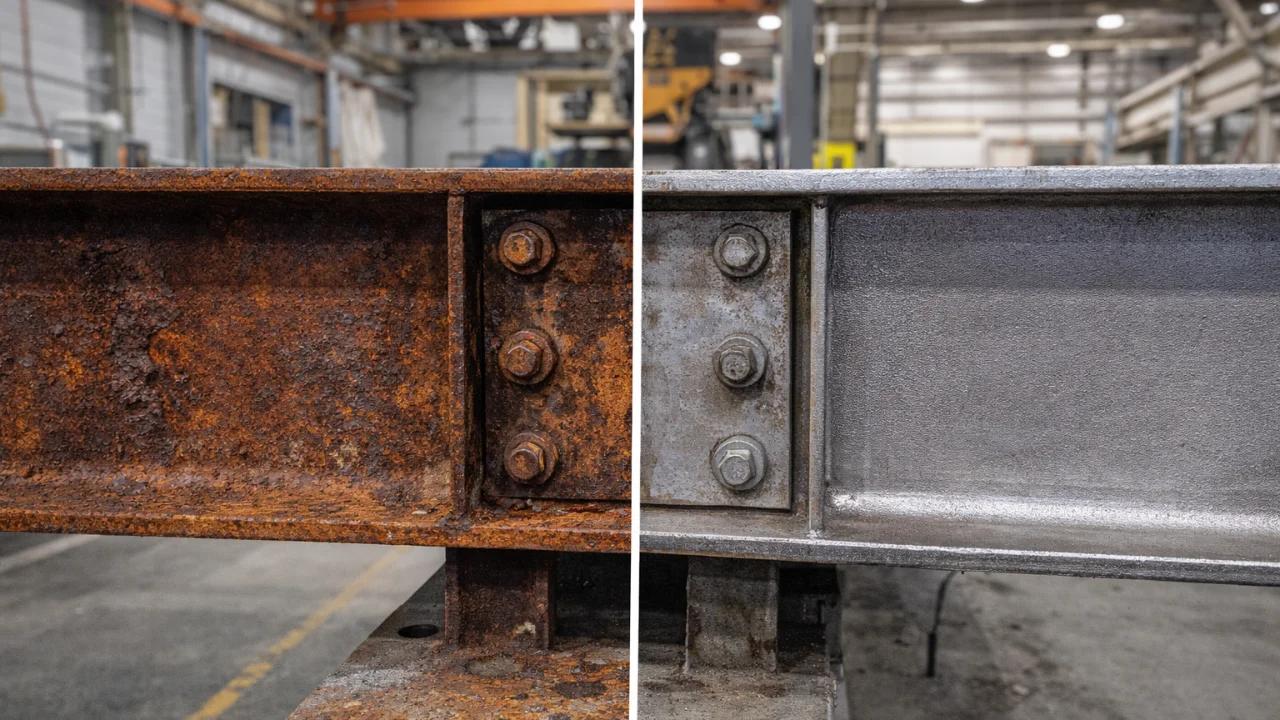
Structural steel is the backbone of industrial facilities, public infrastructure, and manufacturing plants. When corrosion sets in, it is not just a cosmetic issue. Rust compromises load capacity, accelerates coating failure, and increases long term maintenance costs. This case study documents a real world example of Rust Removal from Structural Steel with Laser Cleaning, showing what changed before and after laser cleaning was introduced.
Background of the Project
The project involved exposed structural steel inside an operational industrial facility in the United States. The steel supported overhead equipment and walkways and had been in service for several decades. Over time, moisture, temperature changes, and airborne contaminants led to visible corrosion across beams, brackets, and connection points.
Previous maintenance relied on hand grinding and localized abrasive blasting. These methods were time consuming, created dust, and required frequent shutdowns of adjacent operations. Management needed a solution that could remove rust effectively while keeping disruption to a minimum.
Condition Before Laser Cleaning
Before laser cleaning was introduced, the structural steel showed clear signs of deterioration.
Observed issues included:
- Widespread surface rust and oxidation
- Flaking corrosion around bolted connections
- Coating failure in high moisture zones
- Reduced visibility for inspections
- Concerns about long term asset life
Traditional blasting was considered but rejected due to containment requirements, cleanup time, and the risk of abrasive media spreading into nearby equipment. This led the maintenance team to evaluate Rust Removal from Structural Steel with Laser Cleaning as an alternative.
Why Laser Cleaning was Selected
The decision to use laser cleaning was based on several practical factors rather than marketing claims.
Key reasons included:
- Ability to clean steel without abrasive media
- Minimal secondary waste generation
- Precise removal of rust without thinning the steel
- Reduced setup and cleanup time
- Suitability for indoor use with extraction
The goal was not to replace every maintenance method, but to find a controlled process that worked in tight operational spaces.
The Laser Cleaning Process
The laser cleaning system was brought into the facility and positioned near the affected steel. Operators established a controlled work zone and installed localized fume extraction to capture particulates generated during cleaning.
Laser parameters were adjusted based on the thickness of corrosion and the type of steel. The process involved moving the laser head slowly across the rusted areas, removing oxidation layer by layer.
During cleaning, operators observed that the rust was removed cleanly, revealing intact base metal beneath. No sparks, grit, or chemical residues were introduced into the surrounding area.
Condition After Laser Cleaning
After laser cleaning, the condition of the structural steel changed significantly.
Results included:
- Complete removal of surface rust and oxidation
- Clean steel surfaces suitable for inspection
- No measurable loss of base material
- Clear visibility of welds and fasteners
- Improved surface readiness for recoating
The steel retained its original profile and dimensional integrity. Inspectors were able to assess weld quality and connection points more clearly than before.
This outcome demonstrated the effectiveness of Rust Removal from Structural Steel with Laser Cleaning in a real operational environment.
Impact on Maintenance and Operations
Beyond surface appearance, laser cleaning had a noticeable impact on maintenance efficiency.
Operational improvements included:
- Shorter maintenance windows
- Reduced cleanup time
- No need for abrasive disposal
- Less disruption to nearby operations
- Improved planning for future coating work
Maintenance crews reported that laser cleaning allowed them to work more precisely and predictably compared to previous methods.
Long Term Value Observed
While this case study focused on a single project, the long term value was clear. By preserving base metal integrity and improving coating adhesion, the facility extended the expected service life of the structural steel.
Reduced rework, fewer shutdowns, and improved inspection outcomes contributed to a stronger maintenance strategy. These factors reinforced the decision to adopt Rust Removal from Structural Steel with Laser Cleaning as part of ongoing asset preservation efforts.
Role of Clean Laser Technologies
The laser cleaning system used in this project was supplied by Clean Laser Technologies. Their equipment is built in the USA using globally sourced components and designed for daily commercial and industrial use.
Clean Laser Technologies supported the project by:
- Recommending appropriate machine configuration
- Providing operator training and safety guidance
- Assisting with process setup and parameter selection
- Offering ongoing technical support
This level of support helped ensure the cleaning process was executed safely and effectively.
Final Observations
This before and after case study shows that laser cleaning is not just a theoretical improvement over traditional methods. When applied correctly, Rust Removal from Structural Steel with Laser Cleaning delivers measurable benefits in real working environments.
The ability to remove corrosion precisely, preserve base material, and reduce operational disruption makes laser cleaning a valuable tool for facilities responsible for long term steel asset maintenance.
For organizations evaluating modern approaches to corrosion control, this case study highlights why laser cleaning is becoming a trusted solution across industries in the United States.
Contact Clean Laser Technologies by sending them an email at info@cleanlasertechnologies.com or call at +1601-565-0063


